



District Newsletters

The Association produces two different types of news publications. The SCACR magazine, Soundbow, is produced quarterly, and each District also produces regular newsletters.

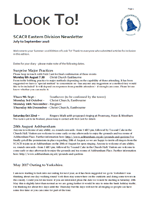
The newsletters include District news and information about upcoming practices, social events and meetings. Each of the four Districts produces regular newsletters: Northern News, Sally Forth (West), Look To! (East), and Southern News.
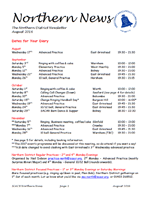
Northern News Sally ForthSouthern NewsLook To!

All four newsletters are available by email or by post. All SCACR members should automatically receive their District's newsletter, which is included in the SCACR annual subscription. Any member can request to be added to the email list for any or all of the District newsletters (contact This email address is being protected from spambots. You need JavaScript enabled to view it.).

Please send articles and photos to the relevant Newsletter Editor or Publicity Officer:

Northern News: This email address is being protected from spambots. You need JavaScript enabled to view it.
Sally Forth: This email address is being protected from spambots. You need JavaScript enabled to view it.
Look To: This email address is being protected from spambots. You need JavaScript enabled to view it.
Southern News: This email address is being protected from spambots. You need JavaScript enabled to view it.

If you have not received the relevant newsletter(s), please contact This email address is being protected from spambots. You need JavaScript enabled to view it..
Codgers

'Codgers' is a group of ringers across Sussex of all ages who get together to for a 'mini-outing' once a month.  Although members are predominantly from Sussex there are several from other counties. The group will happily ring rounds and call changes as well as more difficult methods. Ringers of all ages and skills are welcome as long as they can handle a bell safely by themselves with reasonable striking.

The 'Codgers' meet once a month, usually on the third Thursday (check the calendar for details). The usual arrangement is to ring at two towers with a pub lunch between towers.

Please get in touch if you wish to join the group, or could help with organising events: This email address is being protected from spambots. You need JavaScript enabled to view it.

Handbook & Annual Report

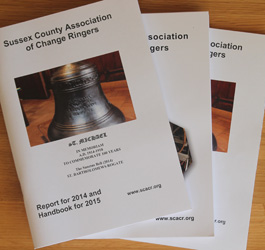
The Annual Report & Handbook is usually prepared around the time of the AGM (May);  The Handbook lists all Sussex towers, including practice and Sunday ringing details, members, and contact details for the Tower Correspondent and/or Tower Captain. Also included are lists of Association Officers and District Committee Members, including contact details. The Handbook includes the following:

  • Association & District Officers & Team members
  • Useful information (e.g. Young Ringers, Publicity Materials, Odd-struckness Meter, and more!)
  • Tower details
  • Annual Reports:
    • Master
    • Association (General) Secretary
    • Treasurer & Association Accounts
    • Bell Restoration Fund
    • District Secretaries
    • Communication & Events team
    • Training & Recruitment Team
    • Safeguarding
    • Library
    • Peals
    • Bell Restoration Fund
  • Quarter peal list
  • Peal list and analysis
  • List of Honorary Life Members & Long Service Members
  • List of unattached members
  • Past officers
  • Belfry prayers

All association members are entitled to request a printed copy of the Annual Report & Handbook when renewing their membership. The report is included in the annual subscription. The Handbook is available via Membermojo.

Non-members can request a copy from the Association Secretary (This email address is being protected from spambots. You need JavaScript enabled to view it.); a small charge applies to non-members to cover printing and postage costs.

What is Bellringing?

Bellringing is a team activity for people of all ages and from all walks of life. Although some ringers are members of the church where they ring the bells, many ringers are not - you don't have to be Christian to ring the bells at a church. Many consider ringing to be their contribution to church life, others do it for the pure pleasure and the company it brings.

Bellringing is an excellent way to keep both mind and body fit and active. Ringers are part of an inclusive and extensive community - at their local tower, within the county, across the UK and even internationally. 

"When I’m ringing I forget all the tensions and frustrations of the day. Even better: I couldn’t wish for a nicer group of friends!"

Read on, or contact us and learn more about opportunities to ring near where you live.

Change Ringing

The origins of change ringing lie in the sixteenth century when church bells began to be fitted with a full wheel. This gave ringers control of their bell, allowing sets of bells (rings) to be rung in continously changing patterns.

Music is created by altering the order in which the bells sound. This is done in defined sequences of changes called methods. Learning a few simple methods allows ringers to join in with other bands in towers around the world. Changes can be rung on tower (church) bells or on handbells.

Find out more about the history of ringing in Sussex.

Interested in learning to ring? Bellringers in Sussex would welcome you as a new recruit! Read on to find out more about learning to ring.

1885-2010: The First 125 Years

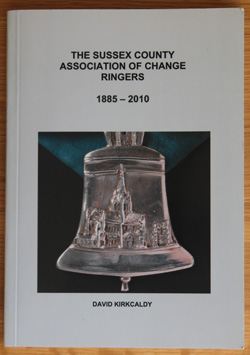
Book cover page

David Kirkcaldy (Master of the SCACR 2010-2013) has published a book about history of the Association:

“The Sussex County Association of Change Ringers 1885-2010: A History of its First 125 Years”

At many times over the past 125 years, Sussex has been at the forefront of ringing, from the Horsham Society of Bellringers and their early peal ringing exploits to some of the more humble village bands. This book follows the trials and tribulations of the Association from its beginnings to the present day. It describes the strong characters who may not always have been in agreement with one another but who have shaped the SCACR into what it is today.

184 pages, with 79 B&W and colour illustrations. Cost £10, plus £3.30 p&p (cheques payable to D Kirkcaldy). Available from 27 Hills Road, Steyning, West Sussex, BN44 3QG. Copies also available from the Association's ringing bookstall (LINK). Any queries, please contact David on This email address is being protected from spambots. You need JavaScript enabled to view it., or phone 01903 813653.

ISBN 978-0-9558942-1-3 (Holden Press) Copyright David Kirkcaldy 2012.

Looking after Children and Young People in the Belfry

February 2015

Downloadable version: Looking after Children and Young People in the Belfry

  1. The parents or guardians of the young person (referred to here as the parents) should complete a consent form at the earliest opportunity when the young person starts to learn to ring. The parents should be encouragedto come to an early lesson to see what is involved. This form* should be kept securely, whilst accessible to the person/s responsible for children in the belfry. It should be updated as necessary.
  2. The Tower Captain should endeavour to establish that the young person has no known medical conditions that may affect safety.
  3. The Tower Captain should make sure that the parents are aware of and give consent for arrangements for young people travelling to and from ringing
    activities.
  4. The parents should be told if there is any plan to use a video camera or still photography as a training tool or for any other purpose. A separate consent form* must be completed and signed by the parents. All photographic recording should be destroyed after use at a time agreed with the child and parent, preferably in the presence of the parent and the Tower Captain.
  5. The child / young people should undertake to ensure that suitable clothing is worn for all ringing activities. It should be loose under the arms to allow
    freedom of movement and not overtly provocative. These requirements should also be made clear to parents at the outset.
  6. The parents should be informed that to act with sufficient speed in an emergency or when learning to control a bell, it may be necessary to raise one's voice, or make physical contact (e.g. by taking hold of the learner's hand to take control of the bell rope). This can be demonstrated to the parents during their early visit to a practice. Procedures for acting in an emergency should be rehearsed, e.g. following the instruction 'Let Go' if the bell gets out of control.
  7. The Parochial Church Council (PCC) should be given the name of the Tower Captain and/or any deputies who may run the practice or ringing sessions
    involving children. Those people will need to apply for a Disclosure and Barring Service check (DBS) through the Parish Safeguarding Officer.
    * Consent forms are available from the SCACR Website or from the Safeguarding Officer.
  8. If an outing is planned, parents should sign a detailed consent form*. Transport arrangements should be made so that young people travel in a car preferably with two adults, one of whom must be DBS checked. Where, in an exceptional circumstance only one adult is available, that person should be DBS checked and the young person should sit in the back of the vehicle.
  9. Where a parent is always present during ringing, e.g. as a member of the band, the parent is responsible for the young person's welfare. However, it is important to bear in mind that there may be occasions when a parent cannot be there or the young person is taken out by other members of the band (e.g. to another tower). As with other aspects, it is advisable to follow the standard procedure in all cases so as not to make an issue of any changes in routine.
  10. Two adults (if possible of different sexes) one of whom must be DBS checked should normally be present whenever young people are taking part in ringing or being transported to or from ringing events. The Tower Captain should endeavour to ensure that at least two adults arrive at the start of any planned ringing when young people are involved.
  11. The Tower Captain should not delegate responsibility for the care of the young people unless it is to someone previously notified to the PCC and who
    has completed a DBS check.
  12. It is good practice for an attendance register to be kept and completed, including the recording of the names of any visitors.
  13. Young people should not be allowed into a potentially hazardous situation unaccompanied.
  14. Normal Health and Safety issues should always be taken into consideration, and if possible a trained first aider should be present. A first aid kit should
    be available and an accident logbook kept. 
  15. Tower Captains are responsible for ensuring that these guidelines are followed and a copy should be displayed on the belfry notice board.  Consent forms are available from the SCACR Website or from the Safeguarding Officer.

This document is based on the CCCBR Guidance Note 3.
Revised by Safeguarding Officer SCACR February 2015.

Learning to Ring: FAQs

“Do I need to go to church to be a bellringer?”

Although most rings (sets) of bells are located in a church, you don’t need to be a member of the church (or even Christian) to learn to ring! Ringers come from all backgrounds and faiths (or none), and most local bands would be delighted to have a new recruit, whether or not they go to church.

“Do you need to be very strong?”

No – ringing is about skill, not strength!

“Is it like the Mars bar advert?!” (a.k.a. “Do you get lifted off the ground?”)

In a word, no!

“I find it difficult to get up/down steps”

That’s OK, there are lots of towers where you ring from the ground floor. For Sussex, you can search the tower listings for ground floor rings (tick the “ground floor” box in the Advanced Search).

“Isn’t bellringing just for older people?”

You can take up ringing at almost any time of life – we have ringers of all ages, from 9 to 90! Sussex is lucky to have a thriving Young Ringers group, and although small children may have to grow a bit before they can start to learn on tower bells, they can still enjoy handbells and mini-rings. Many people take up ringing in later life too.

“Isn’t it very loud?”

No - you don’t stand in the same room as the bells.

“But I don’t read music”

No problem – change ringing doesn’t use musical notation.

“I have a disability, can I still learn?”

Almost certainly – people who are deaf, blind or have some other disability can still have a go. As for able-bodied people, ringing is within most people’s capabilities, but is not necessarily everyone’s cup of tea. Why not have a go and see how you get on? Or, if ringing tower bells isn’t for you, why not try handbells instead (or as well!).

“How much does it cost?”

Learning to ring is usually free, but occasionally there’s a small fee (usually only for an organised course). You “pay back” by ringing for church services, weddings and special occasions – once you’ve reached a good enough standard.

“What do you wear?”

Something comfortable that is not too short or tight fitting is best. You need to be able to lift your arms above your head. High heels should be avoided!

“How long does it take to learn?” (a.k.a. “But you just pull on a rope, right?”)

The first step is to learn how to handle a tower bell safely and with sufficient control to be able to adjust its speed and to start and stop it at will. Everyone learns at their own pace, so you may master this in your first session, or it may take several sessions. Then you can start to ring with the rest of the band... You can stick to ringing simple things, or make it as complicated as you like – change ringing can be a lifelong learning experience.

“OK, you’ve persuaded me! How do I get started?”

Read our Learning to Ring page!

What We Do

The Association arranges various activities and events in order to support and promote change ringing on bells in Sussex. These are organised at Association or District level – anyone is welcome to attend events in any District, not just their own. Check the events calendar or District newsletters for details of upcoming events.

District Events

Each District holds a programme of events on Saturdays throughout the year. These include ringing practices, social events, or both! The District Committees also organise regular practices on weekdays. Any member can go to any District event. Check the calendar for details.

Northern District

  • 1st Saturday of the month – ringing and social get-together; varying between morning and afternoon.
  • 1st Monday – Advanced 7/8 Bell Practice: Stedman Triples & Surprise Major. 
  • 2nd Monday – Moving on to Methods Practice: all welcome, including newer ringers looking to develop their skills and more experienced ringers as helpers. This practice will include rounds and call changes, Kaleidoscope exercises, leading and listening skills, developing ropesight, intro to Plain Hunt, up to Grandsire and Plain Bob Doubles.
  • 3rd Monday – Minor methods practice: from Plain Bob up to Surprise Minor
  • 4th Monday – General 10/12 Bell Practice: rounds onwards, all welcome! Rounds and call changes, plain hunt, plain and surprise methods are usually rung.
  • Other practices – additional practices (e.g. elementary or ringing up/down) are occasionally held on 5th Monday evenings.

Western District

  • 1st Saturday of the month – Beginners & Improvers Practice: Washington
  • 2nd Saturday – General Social practice with tea or other social event. Varying between morning and afternoon.
  • 4th Saturday – 6 bell Surprise practice - Walberton (Treble bob and surprise methods)
  • 1st Friday, 7.30 pm – Basic 8 Bell Practice
  • 3rd Friday, 7.30 pm – 'Stedman onwards' 7/8 Bell Practice

Southern District

  • 1st week of the month: Surprise Major practice (joint with Eastern district)
  • 4th Wednesday – 'Progressing in Minor' practice (joint with Eastern district). Only one method will be rung at each practice - this may be plain, treble bob or surprise. Those wishing to ring the treble are welcome but it will be to the set method.

Eastern District

  • 1st week of the month: Surprise Major practice (joint with Southern district)
  • 4th Wednesday – 'Progressing in Minor' practice (joint with Southern district). Only one method will be rung at each practice - this may be plain, treble bob or surprise. Those wishing to ring the treble are welcome but it will be to the set method.
  • 4th Saturday – monthly ringing event (occasionally held on 3rd Saturday)

Young Ringers

Regular events are organised to provide opportunities for Sussex Young Ringers to ring together, develop their skills and eat cake! More details on the Young Ringers' page.

Codgers – Monthly Mini-Outing

Codgers is a group of ringers across Sussex of all ages who get together to for a 'mini-outing' once a month, usually on the first Wednesday. The group will happily ring rounds and call changes as well as more difficult methods.

Annual Association Social

The Association holds an annual social event, usually on a Saturday in October. In recent years there have been many different types of event, including a canal cruise, barn dances, quizzes, and dinners.

Ringing for Special Events

You can find out about nationwide ringing events by looking at www.cccbr.org.uk/things-to-ring-for

ADMs and AGM

Annual District Meetings (ADMs) take place on Saturdays in February, following the same pattern as for Saturday events. The District Committee members are elected and Association Officers are nominated.

The Annual General Meeting (AGM) usually takes place on the second Saturday in May. The four Districts take turns to host the AGM. The main business is to approve the previous year’s reports and to elect Association Officers.

Committee and Team Meetings

The elected General (Association) and District Committees meet regularly to organise the running of the Association and plan events. Four volunteer Teams also meet to discuss and organise particular aspects of the Association’s activities. For more information, see About the Association and About Committees & Teams.

Events Calendar
About the Association
Committees and Teams

Support our work

Join or Renew Membership

Donate Now

Upcoming Events

10Oct
14Oct
15Oct
Thu Oct 15 @10:30
Codgers